Thursday, September 11, 2014

The Grand Reunion

 Doug Meek and his father, Brad Meek of the noted Meek family of Fiddlers. (7 September 2014)

7 September 2014:

      It took me a while to figure out what was going on, but bluegrass music has a way of making you eventually see the light. Then I got home and downloaded all my pictures and it became abundantly clear in all my photos from Jumbo Jimmy's Crab Shack. There was a Grand Reunion going on and the Master of Ceremonies was the incomparable Danny Paisley and his group of excellent musicians known as "Southern Grass." Danny Paisley and Southern Grass was the reason I was at Jumbo Jimmy's Crab Shack. He's been busy touring all summer and to see him perform in front of a huge audience is one thing; to see him perform (and have fun) up close and personal in a place like Jumbo Jimmy's and in front of family and friends is quite a different experience indeed. I therefore felt like one of the fortunate few who was there to experience it. Earlier in the week Brad Meek asked me if I would be there on Sunday. I gave him an affirmative. Brad is the father of the brilliant and talented (and very young!) Douglas Meek, primo Fiddler for Danny's band. I don't get to see Brad very often. Joyce Miller and Fran Honeycutt greeted me when I came into Jimmy's and both let me know their families would be on hand to see Danny Paisley. Pretty soon I was introduced to cousins, relatives, aunts and uncles, and the proceedings and dancing got pretty raucous as Danny commenced to do what he does best: play music.

      He played to a full house of  friends and family and people who love Danny Paisley and accept his music and his talent. I would imagine that Danny Paisley's style of singing and interpreting the music wouldn't be everybody's cup of tea. At times he's almost bordering on caterwauling and yelling, but there are times where he's absolutely brilliant in the expressed emotion. He knows exactly where he wants to go with any given song selection. It sounds so darned good for another huge reason: keeping up with every audible level, every note, every change in nuance is bassist Eric Troutman. The vocal work of Eric and Danny is reason enough to catch a Danny Paisley performance, but then add the vocal and banjo of  Mark Delaney. Mark Delaney is also an excellent soloist in his own right, but rarely solos when playing with Southern Grass. I hate the hackneyed term 'Deadly.' More confirming to say that the ultimate goal has been reached by Danny and Southern Grass - this is a team effort to produce authenticity and good music. Each member recognizes the talent and potential of the other. That kind of leadership comes down from the top - every Marine knows that and accepts it. One of the most difficult things in music is to instill teamwork among a bunch of acoustical pickers. It doesn't take long for an audience to catch on to a 'Hot-Dog' especially in bluegrass music. They don't last long on a stage or at a local jam. This why I love bluegrass. What seems so simple in the hands of a master like Danny Paisley doesn't explain all the complexities of putting together a masterful package. You have to listen to, and understand the intricacies. To repeat an old, over-used cliche, it takes everybody playing off the same sheet of music; but taking time to show-case your talent is an added bonus when you're watching and listening to Danny. This is where Ryan Paisley, Mark Delaney, Eric Troutman, and Doug Meek really shine forth. And when it happens to be really good, you're rewarded with that crazed Danny Paisley Smile.

      I felt privileged to see a lot of that smiling last Sunday. The dance floor was hot. Nobody wanted the two encores to quit. On a rare and delightful Sunday evening nobody wanted Danny and Company to pack up their instruments and go home. There were lots of  Millers, Paisleys, Lundys, Honeycutts, and Abels in the audience having a grand impromptu Family Reunion of  the representative families of Maryland Traditional bluegrass. Once in a while the planets line up just right. The driving force is bluegrass at its best. What a great time to spend with Brad and Doug Meek. Till I see you again, Brad.


Bobby Lundy and Gail Honeycutt Abel


T.J. Lundy and Mom, Joyce Miller


Some of the regulars from the "1 O'Clock Orchestra" at Jumbo Jimmy's Crab Shack: Rex Smith, Leon Werkheiser, Jerry Riecke,  and Dave Armstrong.

Friday, September 5, 2014

Yes. I'm Still In Love


 Yes. We're Still in Love

5 September 2014

      Hello My Friend! I found a beautiful picture of my wife the other day and I posted it to Facebook. I want everyone to know how beautiful she is. I also posted the caption "Yes. I'm still in Love!" After posting I sat back and decided it was time to return to talking about where I am with my Catholic Faith. If we don't think about these things they have a tendency to slip to non-priority. In the past few weeks I've been missing mass and that usually sends me down the guilt-path. When I converted to The Church I made a promise to love, honor, and obey the Teachings. Lately I've been lax in loving, and lax in honoring. I'm not happy right now with the changes in the liturgical verbiage. I've talked to other Catholics who are in the same boat. The central meaning  is still there, but being a Convert it took me a while to learn and properly recite all the old parts of the liturgy, and now I have to re-learn certain key parts of the newly re-arranged prayers. Just one more thing to cause me to take umbrage with the authorities! But in the end it's such a piddling matter to get angry over. Yes, I'm still in love. I'm in love with my wife and I've promised to love Christ's teachings. And I've promised to accept and honor the love that's being offered to me each time I take the Eucharist during mass. There have been any number of times in my short career as a Catholic that I've been struck to the core as a Convert to the Church. Father Dan Mode told me in a private conversation two years ago that the central teaching of  Christ and the central teaching of  the Church has everything to do with saying "Yes." The second teaching is this: Christ came into the world to direct each of us toward an understanding of God's unconditional love for each of us. I'm simply a human male married to a wonderful woman who bore our son, but beyond that she gave me riches I could have never imagined when I was a young, stupid, unmarried male. I may have never become a Catholic (a very happy one - you need to understand that) without her constant, loving help. Without her, I may have never understood the connection between my telling her how much I love her, and at the same time expressing those same words each time I take Communion with Christ and my Church. It's the "Yes" that Father Mode was talking about. It's all a big mystery as one favorite priest once told me. Life is a lot more fun when you find the joy in it instead of any sorrow. My complaints are meaningless and piddling in comparison to God's Great Plan for each of our lives. I'm still in love with Connie and that's such an easy choice. So much easier if  I  realize that my marriage is a sacramental gift I received when I made my final decision to convert to Catholicism.  +

Wednesday, September 3, 2014

It Sounds Better in Maryland.


3 September 2014:

      I admit my faults; my prejudices. But I've been spoiled. Treated like a spoiled child in a candy shop. Everyone knows I live in Virginia and sneak across the Potomac River to enjoy the bluegrass music in Maryland. I'm frequently asked why I do it so I'll say it once again for the record:  every weekend, every day of every weekend and sometimes on Thursdays, I can find entertaining, first-class bluegrass within a 70-mile range of my home in Virginia. But not in Virginia. I find it in Maryland. Last December I commenced my Maryland Traditional Bluegrass Calendar to document how much Traditional bluegrass was going on in Maryland. In January or February I plan on making a report of the findings, and then continue the calendar/schedule/listings on into 2015. The unscientific research is strictly mine and doesn't include Old Time music, or non-traditional bluegrass groups of which, there are plenty in Maryland, working the clubs, festivals, public picnics, and County-sponsored public concerts. No. My only concern is traditional bluegrass;  music done in what is commonly referred to as "the Baltimore style" or  "the Maryland/Baltimore style." The nick-names are strictly regional and probably have nothing to do with reality. Suffice it for me that I like whatever it is, and I like what I'm hearing when I have the opportunity to seriously listen to it.

Tuesday, August 26, 2014

The Old Bowie Town Grille Launches Bluegrass


 Gerry Stover, George Fehlner, Evan Clark, and Bob Graber on Bass

24 August 2014 - Bowie, Maryland

     There were other places I could have been, but I didn't want to miss this. It's not every day you get to see a new band do its first-ever paid gig in front of a live audience. It may not sound like much to you if you're not a part of the entertainment business, but I know what's at stake for the entertainers. This is the point where you can either prove or disprove that you've got the stability and cajones to get up in front of people and belt out a song or play an instrument with any amount of gumption. You hope they applaud and like you. Or you hope to God there isn't some drunk in the back who's going to boo you. The majority in the audience (unless they're musicians or performers themselves,) wouldn't dare get up there and do what the entertainer is doing. They're paying money for the entertainer to do it. The majority in the audience simply lacks the guts to do it. Dale Carnegie made a fortune in the 20's and 30's off a fact he discovered early on in his successful business career. People would rather die than get up in front of a room-full of their peers  and deliver a talk; a speech, or a sales pitch. Carnegie discovered this simple dynamic, this human foible, long before the pseudo psycho babblers of the 70's and 80's attached pseudo psycho names to it. How about good old stage fright? Yeah. That'll work. There's this air of scary apprehension. Failure, success, or worse yet, polite, soft clapping of  hands, like the soft, muffled sound of 80 or 90 cats pawing each other on the head.

      It wasn't only the debut of a new bluegrass band called The Cypress Creek Bluegrass Band. Bobby Joe Owens, owner/proprietor of the Old Bowie Town Grille had a lot riding on this gig, too. The venue has a reputation for keeping a sizable audience of regulars happy with a steady diet of good food and classic rock and roll and classic country. It's one of the last bastions of classic country. None of that pretty-boy new country stuff (I call it California Male-Model Country). No. I'm talking Merle, George, Conway, and Patsy. Some months ago I was in the Grille to hear some country and Bobby Joe and I got to talking. He was pumping me with questions about bluegrass. I knew something was on his mind. Then he showed up more than a few times at some of the bluegrass venues I hang out in. Now I knew he was up to something and I suspected he was doing field research. More conversations ensued and he told me he was going to launch a bluegrass program. Test the waters. See what happens. Bobby Joe is a former Marine. I'm a former FMF Corpsman (Third Mar Div and First Mar Div infantry rifle companies, thank you very much!) so we hit it off right away. We were taught to always look at the Big Picture. I knew from conversations that Bobby Joe was staying continuously focused on The Big Picture. He had set a date and had a band lined up. It would be August 24th and it would be a new band with no website, no CD's, nothing but a hope and a prayer that yes, indeed, they would play bluegrass. I asked him numerous times who they were, because I might know one or two of  them or maybe all of them. He couldn't give me much information, just that they were a couple local guys. One notable name popped up. Gerry Stover, the son of  Don Stover, who's known far and wide in the local and national music scene. Gerry had his own musical career going but had taken an eight-year sabbatical from performing to raise a family and establish himself. Born and raised and still living in Bowie, Gerry had played on and off with the other members around Bowie and Hagerstown. But decision time came as it usually does for any musician. Do I keep doing this or do I take care of myself and my family?

      It's 4:15 and after getting lost again (the third time I've gotten lost trying to find "Old Bowie." Some day I'll figure out where I keep going wrong.) I showed up in plenty of time. The upstairs bar and performance room was empty except for Bobby Joe sitting alone with an i-Pad. No customers. No band. I felt more than a little rattled. I hate these Washington/Baltimore suburbs and should move out of this hell-hole  but my housing values keep going up. Anything can happen. Traffic jams, football games, shootings, killings, hazmat catastrophes, anything to upset the best laid plans of mice and men. The emptiness gave Bobby and me time to talk. Ten minutes before five the band showed up and got to work tuning up and testing sound equipment.  At one minute to five the place filled with customers and Bobby Joe went to work glad-handing and greeting old friends, some musician friends and regular customers. I was relieved to see some familiar faces; and not just familiar faces but some of the most solid bluegrass supporters in Maryland. There were lots of seniors and families too, with children; a real mixed bag of curious customers who stayed most of the night and had fun. It was like any bluegrass audience I was so used to being with at other venues.

      At 5:03 pm Cypress Creek did an obligatory instrumental opening to test the equipment and get warmed up. Evan Clark, lead vocalist and guitar, took charge. I've got him pegged. He's a real buckaroo and showman. He's from Davidsonville, Maryland. The first official song was "How Mountain Girls can Love" followed by 19 more songs before they took a break. They pulled out all the old saws; "Sing Me Back Home," Tall Pines,"  "Lorena," "Kentucky Girl," "Black Diamond," an endless list of old chestnuts. The message was clear. They were traditional bluegrass following fixed and rigid boundaries, but the fun was only beginning. The second set included audience-recognizable and audience-familiar stuff  like "Fox on the Run," "Man of Constant Sorrow," and yes, even "Rocky Top" (wherein everybody started screaming at the tops of their voices.) I had to smile at that one. I appreciated that they used a play-list and stuck to it. Nothing worse than watching a group up on stage yammering and saying "Well, what are we going to do Boys?" We had a name for that kind of disorganization in the Marine Corps. It was called a Goat Rodeo. Save that for the high school Sock-Hop or a gratis appearance at your girl friend's graduation party. Evan Clark's take-charge attitude payed off in spades with extremely tight vocals, along with George Fehlner (Burke, Virginia) and Bob Graber (Hagerstown, Maryland). The musicianship was excellent and adequate. No real flash or hot-dogging. There weren't any major disasters, only a seriously dedicated purpose, and that's another piece of  the evening I appreciated. I experienced only two drawbacks and they're mine personally: they could have used a fiddler to punctuate and drive some of  the material (which was a good choice of material, by the way,) and Evan Clark got a little long-winded on some of the jokes. But that's a personal thing with me. Timing and pacing is an entertainment science full of dangerous pit-falls. The excellent vocals and instrumentation would have been enough to keep me happy.

      And I'd also be very happy to see them again at the Old Bowie Town Grille. I'd like to see them with a dancing crowd. I have a feeling there's a whole wealth of song-material packed away in their saddle-bags that wasn't even tapped into. It was an excellent launch and I'm looking forward to seeing how far Cypress Creek Bluegrass Band wants to carry this on into the future.

Evan Clark:  Lead vocals and guitar
George Fehlner: vocals and mandolin
Gerry Stover:  Banjo
Bob Graber: vocals and bass


Tuesday, August 12, 2014

The Emergence of Great Entertainment - Bluetrain and Flavio Sala


 Flavio Sala (Italy) makes his debut at Rob's Barn in Westminster, Maryland, USA on August 9, 2014

9 August 2014:  Westminster, Maryland.


      Terese Hartline, one of the most active and dedicated bluegrass followers in Maryland asked me recently to name my favorite bluegrass band. I thought long and hard for a moment and then told her I had a standard answer for that question: The bands I like, I like for different reasons. One might have more polish than another. One might be gifted with a better fiddler. One might do great vocals while another might be better pickers. I have a hundred different reasons for liking the bands I'll go out to listen to, or drive lots of extra miles to experience; not just listen to, but experience. You can't just listen to a bluegrass group or bluegrass musician. You have to experience their craft; their product. Darren Beachley calls it 'the total package' when he's talking about professionalism in the business. No one would know better than Darren. I've always respected his professional approach to the business, and his professional approach to entertaining his audiences. This past Saturday night and past Sunday afternoon gave me pause to think about these things again. Don't be surprised. I approach my favorite operas the same way I appreciate good bluegrass. One might have a better story-line. One might have more spectacular arias. One might be darkly gothic and typically German, while the next favorite might be typically Italian Bel Canto. My humanities training reminds me that it's helpful to know the historical and cultural backdrop of  how and why certain things happen, and appear, and emerge in the arts, music, language of any distinct time period or national culture. I'm always more interested in the emergence factor. And don't let all the big words fool you. When it comes to bluegrass, I'm just a gad-fly. I have a lot of fun with the emergence factor. To wit: recently I wasted four hours out of my day when a new band didn't bother to show up for an unpaid gig. I really wanted to know who they were and get some photos. So much for thinking about professionalism if you want to break into the entertainment business!

      But there is always a pay-back with the emergence factor; a rich, rich pay-back. Few are willing to risk the invested time and effort. I have to smile at Tony Bennett's story. Coming out of the late 40's Age of the Crooners, he was nearly washed up and forgotten (the public is very fickle!) by the end of the 50's only to emerge later as one of the biggest music stars in the world. He persisted. He believed in himself and his music while the Great Unwashed forgot about him. He evolved and emerged back into universal music consciousness because he was good. He was always good; but it took a long time for the world to realize it. I'm always the Gad-fly sitting in a chair and mulling over these crazy notions while watching a great band that's barely been in existence for a year perform in a Barn in Maryland, or a band that's been in existence for barely four years go from a Beer Bar in Loudoun County right on into Carnegie Hall in New York City. If they're reading this, they know who they are, and God bless them for their courage to stick with it and believe in what they're doing.

      The other band that played the Barn in Maryland is not just any band. And the Barn they played in is not just any Barn in Maryland. Within a short span of a few years, Rob's Barn in Westminster, Maryland has established a unique and extremely special reputation for offering only the best (and closest-to-authentic as you can get,) bluegrass music. The authenticity-part is very important. The audience is demanding. The owner (Rob Miller) is in agreement and accedes to their demands. The plan is pretty simple and undemanding: show us what you got and provide a good evening of entertainment. It's nothing more than what any of the other Maryland bluegrass venues are asking of its performers. But one working environment is as different as the next. As a paying customer I make my choices as to what kind of environment will give me the most bang for my buck. I will naturally choose the environment that offers me the best entertainment. In this, Rob's Barn has emerged. Rob Miller and the team of volunteers who help him with the (now annual) selection and programming of  'Barn Concerts' already has the requisite reputation for offering quality over quantity. I offer all this as backdrop to what happened there on the night of August 9th.

      Rob Miller got an e-mail from a friend of a friend, requesting some help for a young guy from Italy who wanted to establish his musical credentials with some appearances in the U.S. He already had a European fan-base, an established following on You Tube, and now he wanted to spend three years in America. He plays classical guitar. Not quite the genre that the Barn audience comes to expect. But Rob Miller took a chance and convinced his committee it might be fun. Flavio Sala's name soon began to appear in the Barn's promo material for the concert series. He would appear on the 9th as (sort of) the opening act with Dave Propst and BLUETRAIN. It wouldn't so much be an opening act, but more of a prelude entertainment factor. In conversations with the band, I couldn't actually get much information out of them as to what was happening or what was planned for the entrance of the unknown Flavio Sala. Nothing like this had ever happened in a "Bluegrass Barn." Once the evening started, I knew exactly what was happening. It was a full-blown, debut Recital for an extraordinary guitarist. As Flavio Sala talked, gave background information on himself, and gave informative commentary on his knowledge of South American guitar styles (especially Venezuelan) and Venezuelan composers, his rich guitar-playing lifted to the rafters and the audience (composed of a lot of good guitar-players) sat in stunned silence; not in any negative way, but in deep appreciation for his talent. After 45 minutes of playing, which included numbers by Santana and Eric Clapton, the full house erupted with shouts and applause and they demanded two more encore numbers. The look on Flavio's face was priceless. The look on Rob Miller's face was priceless. What happened next was even better. During a short intermission Flavio was swamped by the audience for hand-shakes, expressions of gratitude, congratulatory comments, and lots of questions from all the guitar-pickers in the audience. He said to me in a brief photo-op  "I never in my wildest dreams expected this. I went to one bluegrass event in Italy and I honestly didn't like it. But this is very different. This is so much better!" He could have left after his recital. He stayed to watch and listen to BLUETRAIN. Then he stayed long after closing time to talk to local guitarists. BLUETRAIN just keeps getting better; they're emerging too, musically and as entertainers. What happened was not so much an entertaining musical event, as it was a cultural exchange of the highest order between musical worlds.

      When we finally got home my phone lines and internet lines were buzzing. The main question was "What did we just witness??" Rob's Barn had a record night. Those who had never experienced BLUETRAIN were telling me, "Now I know why you like these guys!" Old Rob's Barn hands were running around proclaiming it the best night ever at Rob's Barn. Well, the success factors are easy to discern. A lot of talented people all gathered in one cozy and comfortable location for an event the likes of which we may never experience again - and it's all still emerging as long as there is a vibrant audience around to appreciate and support traditional bluegrass music.

 BLUETRAIN's second appearance at the Rob's Barn Concert Series  (9 August 2014)


Tuesday, June 17, 2014

"Nope, Never Heard of Them" . . . (But I Know Them Now.)


Roger Eberlin, Tom Cook, Ray Horst, and John Hilton. (Ron McVey is out of camera range)

15 June 2014: Fathers' Day

     I don't know how I get myself in these fixes. Well, yeah, I do. I'm having too much fun in life. Last night I came home (again) from Jumbo Jimmy's Crab Shack in Port Deposit, Maryland. Fortunately, the weekend traffic on I-95 South was light and I could take my time composing my thoughts. On Saturday night Connie and I went out to (Rob Miller's Barn)  in Westminster, Maryland to see Fastest Grass Alive. I should have been working on a piece I'm writing for Marv Ashby and High Octane, but I was way behind. I'll get to the Marv Ashby piece sooner or later. Right now I'm having too much fun. It's nice to be on a roll of having fun with bluegrass. I put Rob's Barn in parenthesis because it's nearly a well-kept secret. Rob Miller and his Committee of volunteers have only recently established a nice web-site and other public connections so they can at least let the Traditional Bluegrass cognoscenti know how to get to this obscure location. Before a few months ago everything was being handled through a massive e-mail list, which is tedious and antiquated. Here's the well-kept secret: Rob's Barn is establishing an operating record of getting, lining up, acquiring, some of the best working bluegrass bands in Maryland, Virginia, and Pennsylvania. What I like about the place is, it's strictly for listening and enjoying the music and everyone who goes there is on the same page about that. It's also staying traditional bluegrass only - no funny stuff. The form will be honored and respected by the best traditional bluegrass players you'll find in Maryland and beyond.

     The Saturday night performance with Warren Blair, Kenny Blair, Steve Streett, Dave Robertson, and Scott Walker was so outstanding that I knew I would have to write it up eventually. Fastest Grass Alive has nearly a legendary reputation among those regularly working the Maryland bluegrass venues. But here I am in a jam. I still owe Marv Ashby some credit. So, being the hopeless addict I am, I got some sleep until 10:00 am on Father's day and then headed out to Jumbo Jimmy's to catch "Chestnut Ridge." For the past several days I've been checking every internet source and calling friends to see if I might find out anything I could on Chestnut Ridge. "Nope, never heard of them" was the response I was getting. There were lots of bands called Chestnut Ridge but none of them matched what I was looking for. Nothing on You Tube, either. Sometimes in my line of having fun I love the total crapshoot. Take the big chance and be totally disappointed or be pleasantly surprised. After all, isn't that what the entertainment business is all about? I had one connection: John Hilton, who plays banjo. It ends up I had been friends with him on Face Book all along and had never met him. I put two and two together. People castigate Face Book for it's superficiality. I would be dead in the water for bluegrass connections and band schedules if I weren't on it. I walked into Jumbo Jimmy's and a few minutes later John Hilton walked in the door. Bingo. We were finally introduced. And he's a good banjo-player by the way. That's the important part of the story. Pretty soon I got into a discussion with Leon Werkheiser and Jerry Riecke and when I inquired as to who these guys were, the full story came out. Chestnut Ridge used to play a lot at Jumbo Jimmy's but hadn't been there in a few years. Aha! There was another odd factor I have to mention: A lot of the usual crowd wasn't there (it was Fathers' Day) and the usual people at the usual tables had all been replaced with folks I didn't recognize! They were all friends, fans, and family of Chestnut Ridge. When a band from Pennsylvania playing in a place in Maryland can fill up a venue with its own crowd, you know you're in for a special treat; sort of like going to a Hillbilly Gypsies event, or watching Marv Ashby and High Octane cause a riot in a great venue like Goofy's up in Spring Grove, Pa.

     There was a major tectonic shift from getting a response of, "Nope never heard of them" to experiencing what the crowd experienced at Jumbo Jimmy's last Sunday when Chestnut Ridge started playing. This is not the greatest bluegrass band you've ever heard, but they're very entertaining and high energy, slowing down once in a while with really old Monroe and Stanley stuff, and some Jim and Jesse. Tom Cook on mandolin broke it all open with his take on Jimmy Martin material. All the vocal work was tight and excellent. I got the impression that a lot of the Chestnut Ridge personal style leaned toward creating an 'Old Barn Dance' atmosphere and there's absolutely nothing wrong with that after weeks and weeks of listening to murder ballads, hanging songs, and tunes about men ditching their philandering wives. I'm way behind and I may never catch up with the story about Marv Ashby and High Octane. I'm having too much fun. I never heard of Chestnut Ridge, but I'm happy to have made their acquaintance and I hope I see more of them around Maryland.

Chestnut Ridge:  Ray Horst, guitar - John Hilton, banjo - Roger Eberlin, bass - Tom Cook, mandolin - Ron McVey, fiddle.

No website available. Chestnut Ridge's members are mainly from the Lancaster, Pa. area and perform in that region. Several of the members are linked with other band configurations.   

Saturday, June 14, 2014

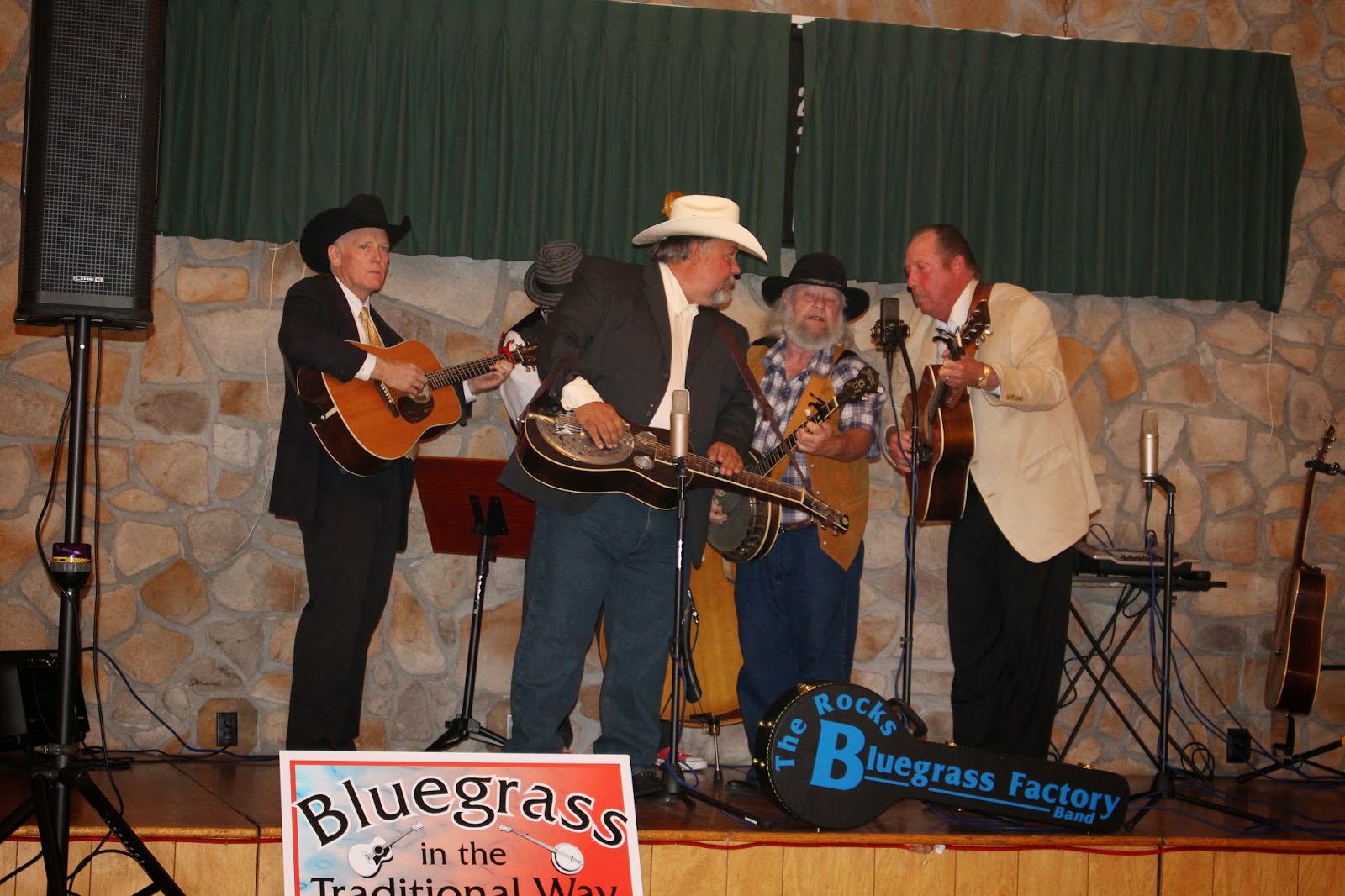
Bluegrass in the Traditional Way - A Special Presentation


 The Rocks Bluegrass Factory Band at the Frederick Moose Lodge, June 7th, 2014

 "They say don't go/ On Wolverton Mountain/ If your lookin'/ For a wife.
'Cause Clifton Clowers/ Got a pretty young daughter/ But he's mighty handy
With a gun and a knife."  - Hit song by Claude King (1962)

7 June 2014: The Moose Lodge, Frederick, Maryland

     You know how it is. A song gets in your head and you can't remove it. This song actually has nothing to do with the show I saw last weekend at the Moose Lodge in Frederick - and it has everything to do with it. The newly formed Rocks Bluegrass Factory Band (Point of Rocks, Maryland) had aligned with the venerable Ernie Bradley and the Martin Brothers and Aspen Run for a full evening of exploration and show-casing of talents. At the center of the Rocks Bluegrass Factory effort is Joey Longwell, multi-instrumentalist and excellent baritone voice. Joey Longwell has been a long-standing member of the bluegrass scene up around Frederick County and some years ago he linked up with Gene Beachley through the Ernie Bradley connection. They played a lot around Lucketts, Martinsburg, and Hagerstown. Anybody who plays with Ernie Bradley is immediately connected to the A-List of  working bluegrassers in the Maryland and West Virginia Panhandles. There aren't many. You would expect the region to be rich in working bluegrass bands and musicians. It's not. The audiences and the interest have dwindled. Working musicians sit around and complain a lot that they can't get monetary support from working their craft. It's a unique dynamic because the region was once the hot bed spawning ground for the greats who established the genre. I still love to travel out in that direction and search out the gatherings and local jams where people are playing and dreaming about teaming up to make a few bucks playing music. There are numerous, marvelously talented bands out there on the edge of the mountains who never get beyond playing the church revival circuits and fruit stand openings, or an annual street carnival. They'll play for free or what's known as "the gate" because the local operators think they either don't need to be paid, or the band is doing a free favor for somebody, usually a relative.

     It's easy to sit by and do nothing. It's easy to accept 'the ways things are.' It takes a little bit more guts and chutzpah to take a step forward and try to change things. Way back in my university days when I should have been studying math and science, but really couldn't stand it because it bored me to death, I began researching the rise and spread of  commedia dell'arte from Italy to the rest of Europe in the 16th Century. Along with that arose a tradition of troubadours and Italian dance masters who had as much to do with the artistic explosion of  the Renaissance as any supposedly intellectual scholar of  the time. What these people had was mobility. From court to court and town square to town square. The mobility was either self-imposed or forced by a local court official or magistrate. Along with the legend of the vagabond life-style arose the wonderful purpose these vagabonds served as exchangers of  ideas, popular stories, and even local news sources. One can't even begin to contemplate the rise of opera, ballet, and what we often refer to as the "higher arts" without considering the early role played by traveling troupes, street musicians and actors, and other assorted entertainers. Once I left my studies and started a career in the historical travel business there was always a side-bar reason why I would leave "The Tour" and seek out the things that interested me the most; like local music for instance, or a local art scene. It didn't take me long to realize that every country in the world has some form of local music and usually that local music had something to do with the establishment of the local culture. I soon realized my university studies had been very myopic indeed. Carl Jung got it right. Deep in the human mental recesses are universal patterns that make us the homo sapiens we are. Subconscious human fears of survival or flight, fantasies of love and romance, and dealing with the loss of another human being. Whether it's the sappy love-songs of  Japanese Enka music or the insipid e-minor lullabies sung by every Vietnamese mother, we pass along our state of humanity on the great DNA chains of each culture and nationality. Nothing made me happier last year than to get an opportunity to travel to the Tatra Mountains in southern Poland and go through the CD stalls in Zakopane.

     I'm sitting at a bluegrass performance in the DC suburbs. Every table was taken and there were empty seats at mine, so a couple asked if they could share the table and I obliged. I introduced myself and then went back to listening to the music. That's what I want to do. I want to listen to the music and study what the musicians are doing. The man who sat down "Harrumphed" a lot. That was aggravating enough. But then he asked me if I knew anything about bluegrass. I asked him what he did for a living and he told me he taught music at a local university. I didn't know whether he wanted to know more about bluegrass, or whether he was trying to set me up for a game of 'dozens.' I said nothing to him. Better for him to try and make the first slice in this Duel of the Minds. He pedantically proceeded to give me (along with a lot of aggravating harrumphs) the stock Music Appreciation 101 (Freshman Level) lecture on how bluegrass came here to this region on the backs of Irish and Scotch settlers and all of today's bluegrass music has these Gaelic roots, and you can hear it in every bluegrass song. I listened to this drivel for a half-hour before I got up and left and told him to have a nice day. I never asked him where he taught or what he taught. I didn't want to know. I wanted to ask why then, did the same note structures, chord patterns, and lyric ideas show up in Japanese, Vietnamese, English, Filipino, and lo and behold, Polish Mountain Music?

     About two years ago Joey Longwell and Gene Beachley started posting home-made videos on You Tube. There is some wonderful stuff up on You Tube and then there is the inordinate amount of crap and trash. You know what I'm talking about. Joey posted his songs first and his solo work is good. Not exceptional, but very enjoyable. Then he invited Gene Beachley to add his high lonesome tenor and the videos became even more interesting. I watch a lot of You Tube stuff whenever I have to check out a band or musical act I'm unfamiliar with. I'll normally watch a minute of something and if I hate it, it immediately gets the delete button. Joey's little productions are interesting. And again, not exceptional, but promising in the simplicity of it. Just two guys, two guitars, and a microphone. Basic back-porch stuff.  Music I remember as a kid back in my neighborhood when some of the men would get together with their guitars and drink beer. Joey packs a wealth of old bluegrass standards. Gene Beachley is comfortable with the old honky-tonk, dance-hall tunes, the stuff of  drinking and she-done-me-wrong songs that you know will lead down the road to murder ballads. It's easy to laugh at it; make fun of it. The Professor probably would. It's a lot more complicated to observe it and try to put it into the universal totality of what it represents as art - traditional folk art and living and breathing art for the here and now of today.

     Don't go up on the mountain if you're looking for a wife. You might get your throat cut. There are still scary places up in the Appalachians and you can still lose your life through a bear-attack or snake-bite.  Not a good idea to go up there alone and spend any time unless you really know what you're doing, or if you've had sufficient survival training. The best bluegrass music reflects its primal and primitive beginnings. I seek out the local bands who have the ability to maintain that rough-edge while eliciting the proper response from its listeners. This is minimalist art and not easily accomplished. For an idea of what I'm talking about, take in a few appearances by the Hillbilly Gypsies or Marv Ashby and High Octane. You may not like this kind of music, but you cannot, not listen to it. It's as primitive as it gets. It's primitive on a grand scale. It's also no-joke intended, mountain music. Ernie Bradley and the Martin Brothers and Aspen Run all come out of a basically primitive musical style that we once jokingly referred to as hillbilly music. The years have passed since the 30's and 40's and popular tastes (and Musicology) have re-classified the various threads of the 'bluegrass genre.' Every bluegrass band or entertainer attempts to return to the primitive beginnings. Few succeed. I have my favorites. Everyone who follows bluegrass does. When I sense unnecessary embellishments it's time for me to head toward the nearest exit. When I see a whole crowd of people get up out of their chairs and start dancing, I need to stick around and watch and especially listen to a band closely.

     The "Bluegrass in the Traditional Way" evening of  hard-core bluegrass was a first-time event to introduce and showcase the talents that the Rocks Bluegrass Factory hopes to carry on into the future. It was a first step not without its rough edges, but rough edges are to be expected in any show-case endeavor. The Moose Lodge in Frederick provided an excellent playing space and spacious dance floor that got a lot of use once the Martin Brothers and Aspen Run hit the stage. The best part of the evening shined when it was just Joey Longwell and Gene Beachley up on stage. A naturally talented baritone and a naturally talented high tenor blending their voices in plaintive melodies. Joey added his dobro and gene his old Martin. Primitive. And it sounded just right.

The Rocks Bluegrass Factory Band:
Joey Longwell, guitar, dobro - Gene Beachley, guitar, lead vocals - Jaime Anderson, banjo - David Morris, bass.
Special Guests:  Ernie Bradley, The Martin Brothers and Aspen Run